

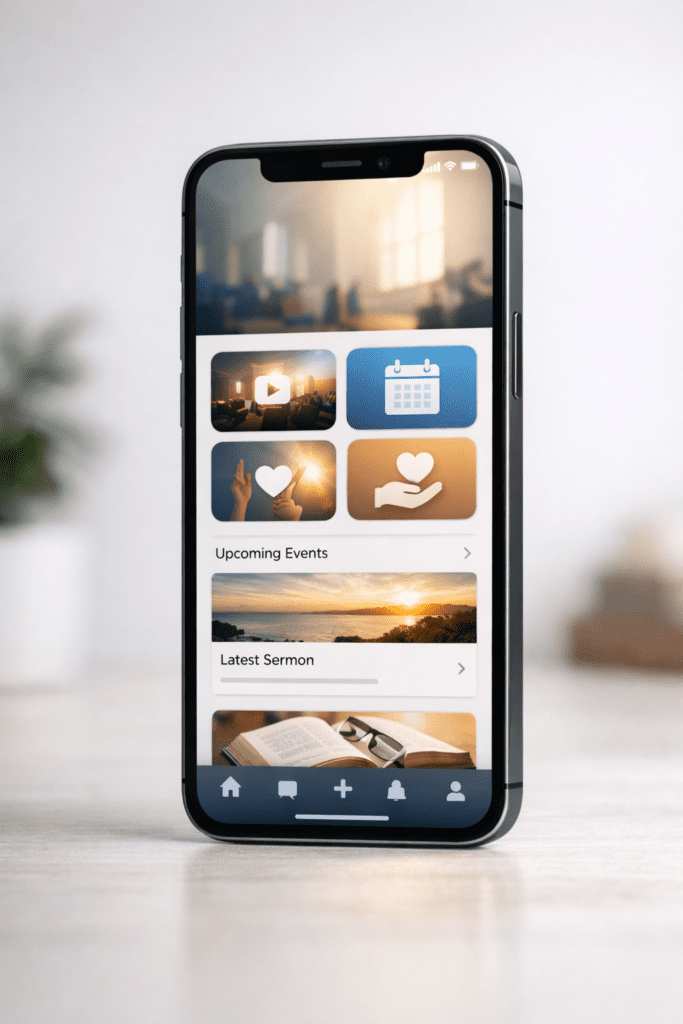
A white-label app gives your church a private digital space that truly belongs to your community. It’s not a public social network. It’s not another tool competing for attention. It’s a branded, church-owned app designed to help people stay connected, supported, and engaged throughout the week.
At its heart, this kind of app is about relationships. It creates a simple, familiar place where your church family can gather digitally—to share prayer requests, encourage one another, communicate clearly, and stay connected beyond Sunday.
For churches seeking to strengthen community without adding unnecessary complexity, a white-label community app offers a thoughtful and pastoral approach to digital ministry.
Do churches really need a mobile app?
The Church does not depend on technology to be the Church. Scripture, community, and the work of the Holy Spirit remain central. But churches do need practical ways to shepherd people, communicate clearly, and foster belonging in everyday life.
For most people, everyday life already happens through their phones. Conversations, updates, reminders, and relationships are increasingly digital. When churches lack a clear digital gathering place, communication becomes scattered across social media, group texts, emails, and third-party platforms.
A white-label church app doesn’t replace real community—it supports it. It creates a consistent space where people know they can go to stay connected to their church family throughout the week.
What is a white-label app for churches?
A white-label church app is a fully branded app that carries your church’s name, identity, and voice. When members download it, they aren’t joining a generic platform or public network. They are entering a digital space that belongs to your church.
From the outside, it feels custom-built. From the inside, it’s built on a stable, proven framework that allows your ministry to focus on people rather than technology.
More than anything, a white-label app functions as a private community platform—one designed specifically for church life, relationships, and care.
A digital space designed for belonging
Churches are more than events and services. They are communities shaped by shared faith, care, and presence. A white-label community app reflects that reality in a digital form.
Instead of one-way communication, the platform encourages participation. People aren’t just receiving information—they’re engaging with one another.
Churches often use this space to:
- Create private groups for ministries, teams, or classes
- Encourage prayer, conversation, and mutual support
- Share important updates in a focused environment
- Help new people feel connected more quickly
Over time, the app becomes familiar. It feels less like “technology” and more like a digital extension of the church lobby—a place where people naturally gather.
Why many churches are rethinking social media for community
Social media can be helpful for outreach, but it often falls short when it comes to shepherding. Conversations are public, attention is divided, and important posts are easily missed.
Pastoral care doesn’t always belong in comment threads. Prayer requests shouldn’t compete with ads and trending content. Community formation requires focus and trust.
A white-label church app offers a quieter alternative. It creates a space free from algorithms and distractions—a place where communication feels intentional rather than reactive.
Because the space is private and church-owned, members know they are interacting within their own faith community.
How a white-label app supports pastoral care
Pastoral ministry happens throughout the week, not just during services. People carry prayer needs, questions, and struggles into everyday life.
A white-label community app supports this reality by giving leaders and members a shared space to stay connected. Encouragement doesn’t get buried. Prayer requests don’t disappear. Communication remains visible and accessible.
This doesn’t replace personal conversations or in-person care. Instead, it strengthens them by helping the church remain present between gatherings.
What makes a white-label community app different from a content-focused church app?
Many church apps focus primarily on content—sermons, schedules, announcements. While these are important, content alone doesn’t always build connection.
A white-label community app is designed around people first.
- It prioritizes conversation over consumption
- It encourages participation rather than passive use
- It helps people feel known, not just informed
Members don’t feel like they’re opening another app—they feel like they’re staying connected to their church family.
How churches typically use a white-label community app
Every church’s culture is different, but many use a white-label app as a central digital gathering place.
Common uses include:
- Group discussions and ministry communication
- Volunteer and leadership coordination
- Prayer, encouragement, and shared life updates
- Helping newcomers integrate into the community
Instead of juggling multiple platforms, the church gains one consistent place where community lives.
Why white-labeling matters for trust and identity
White-labeling is about more than logos and colors. It’s about trust.
When your church’s name and identity are clearly present, members associate the experience with your ministry—not a third-party platform.
This consistency reinforces confidence. It communicates that the space is intentional, cared for, and aligned with the church’s values.
Is this right for every church?
A white-label community app isn’t a requirement or a trend to chase. It’s a tool meant to serve people well.
It’s a strong fit for churches that:
- Value community beyond Sunday services
- Want a private digital space for connection
- Desire simpler, clearer communication
- Care deeply about belonging and discipleship
Churches of many sizes choose this approach—not because it’s flashy, but because it supports faithful ministry in a digital age.
Frequently Asked Questions
Is this meant to replace in-person community?
No. It exists to support and strengthen relationships, not replace face-to-face connection.
Is the app branded for our church?
Yes. The app carries your church’s name, identity, and voice.
Is this a public platform?
No. It’s a private space designed specifically for your church community.
Does this replace our website?
No. Your website remains your public front door. The app supports ongoing connection.
Is it difficult for members to use?
No. The experience is designed to feel familiar and approachable.
Final thoughts
A white-label church app is not about technology for its own sake. It’s about creating space for connection, care, and community in a world that often feels fragmented.
By offering a digital home that belongs to your church, you give people a place to stay connected, encouraged, and engaged throughout the week.
For churches seeking a pastoral, people-first approach to digital community, a white-label platform can be a faithful and practical tool for ministry.