

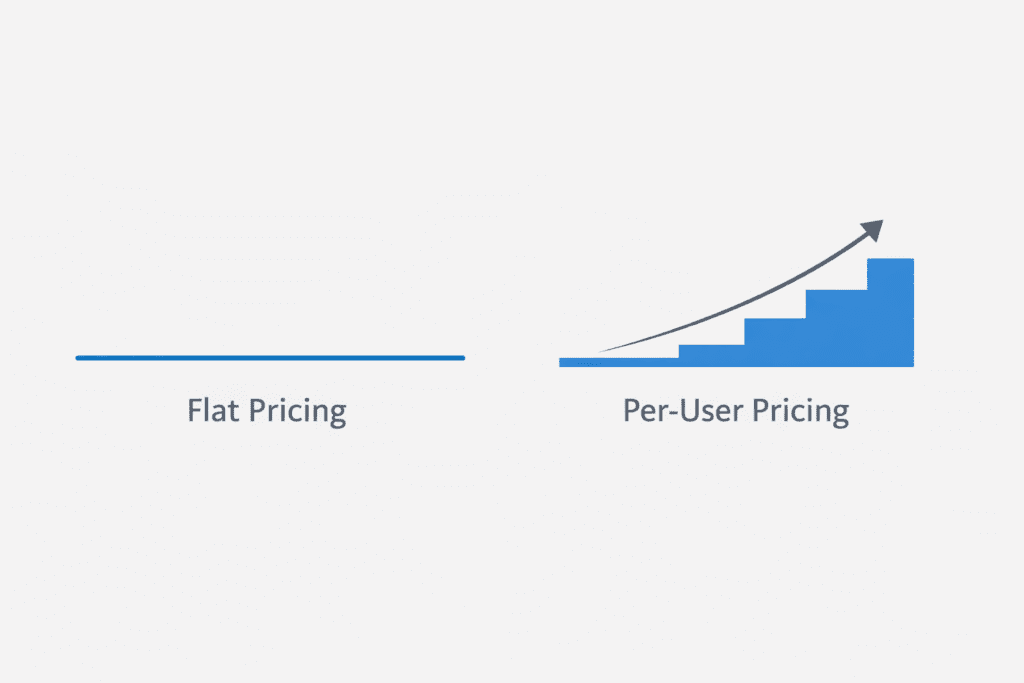
Flat pricing is often the most sustainable church software pricing model because it allows ministries to grow without increasing costs every time a new staff member, volunteer, or leader needs access. Compared to per-user pricing, flat pricing removes budget uncertainty and supports long-term planning.
When churches evaluate church management software, pricing models can have a bigger impact than features. The wrong model can quietly limit adoption, slow ministry growth, and strain budgets over time.
How much should church software cost?
Church software costs vary widely, but the real question is not just the monthly price—it’s how that price changes as your church grows. Many platforms appear affordable at first, then become expensive as more users are added.
A healthy pricing model should:
- Remain predictable year over year
- Support staff, volunteers, and ministry leaders without penalties
- Align with real church budgeting cycles
- Encourage adoption instead of limiting access
Understanding how pricing scales is essential before committing to any long-term platform.
What is per-user pricing for church software?
Per-user pricing charges a fee for every individual who needs access to the system. This model is common in business software but often creates challenges for churches.
With per-user pricing, churches must decide who gets access and who does not. That decision can affect communication, data accuracy, and ministry effectiveness.
Common challenges include:
- Higher costs as staff or volunteers increase
- Limiting access to protect the budget
- Fragmented workflows across ministries
- Difficulty onboarding new leaders
While predictable in theory, per-user pricing often becomes unpredictable in practice as ministry needs change.
What is flat pricing and how does it work?
Flat pricing means one consistent price regardless of how many users access the platform. Whether your church has five staff members or fifty volunteers, the cost remains the same.
This model is designed around ministry growth rather than headcount control. Churches can invite the right people into the system without recalculating the budget each time.
Flat pricing typically supports:
- Unlimited or broad user access
- Full adoption across departments
- Simpler budgeting and approvals
- Long-term scalability
For churches focused on collaboration, flat pricing removes friction at every level.
Why does per-user pricing limit church growth?
Church growth often depends on empowering more people, not fewer. Per-user pricing introduces a financial penalty for doing exactly that.
As churches expand ministries, launch groups, or involve volunteers, access becomes a cost decision instead of a ministry decision. Over time, this can lead to underutilized software and disconnected systems.
This is especially challenging when churches rely on part-time staff or rotating volunteers who still need consistent access to tools and data.
How does flat pricing support better budgeting?
Flat pricing aligns more naturally with how churches budget. Instead of variable monthly expenses tied to user counts, churches can plan for a consistent cost.
This stability helps with:
- Annual budget forecasting
- Board and finance team approvals
- Long-term technology planning
- Reducing surprise overages
Churches already juggle seasonal giving patterns, staffing changes, and ministry expansion. Software pricing should simplify—not complicate—that reality.
Why software consolidation matters in pricing decisions
Pricing should also be evaluated alongside how many tools a church is paying for. Per-user pricing often increases when multiple systems are stacked together.
Flat pricing becomes more valuable when churches consolidate tools into a single platform. This reduces overlapping subscriptions and simplifies financial oversight.
When evaluating options, churches should also consider broader nonprofit software considerations such as compliance, reporting, and long-term sustainability.
Is flat pricing always better for churches?
Flat pricing is not about being cheaper in every scenario—it’s about being healthier over time. For churches that want broad access, shared ownership, and scalable systems, flat pricing removes unnecessary barriers.
Smaller churches may initially feel comfortable with per-user pricing, but growth often changes that equation quickly. Choosing a model that supports where you are going—not just where you are today—matters.
How should churches compare pricing models?
When comparing flat pricing vs per-user pricing, churches should ask:
- How many people need access today?
- How many might need access next year?
- Will pricing increase with volunteers or ministry leaders?
- Does the model encourage or restrict adoption?
The best pricing model supports ministry momentum instead of slowing it down.
Frequently Asked Questions
What is flat pricing in church software?
Flat pricing is a consistent cost model that does not increase as more users are added to the system.
Why do churches struggle with per-user pricing?
Per-user pricing often limits access, increases costs with growth, and complicates budgeting.
Is flat pricing better for volunteers?
Yes. Flat pricing allows churches to give volunteers access without increasing costs.
How does pricing affect software adoption?
Restrictive pricing models often lead to fewer users and underutilized tools.
Can flat pricing help with long-term planning?
Yes. Predictable costs make it easier to plan budgets and technology investments.
Does flat pricing mean fewer features?
Not necessarily. Pricing models and feature sets are separate considerations.
How often should churches review software pricing?
Churches should review pricing annually or when major growth or staffing changes occur.
What matters more: price or pricing model?
The pricing model often has a greater long-term impact than the starting price.
If you’re evaluating software options, reviewing simple church software pricing can help clarify what long-term sustainability looks like for your ministry.