

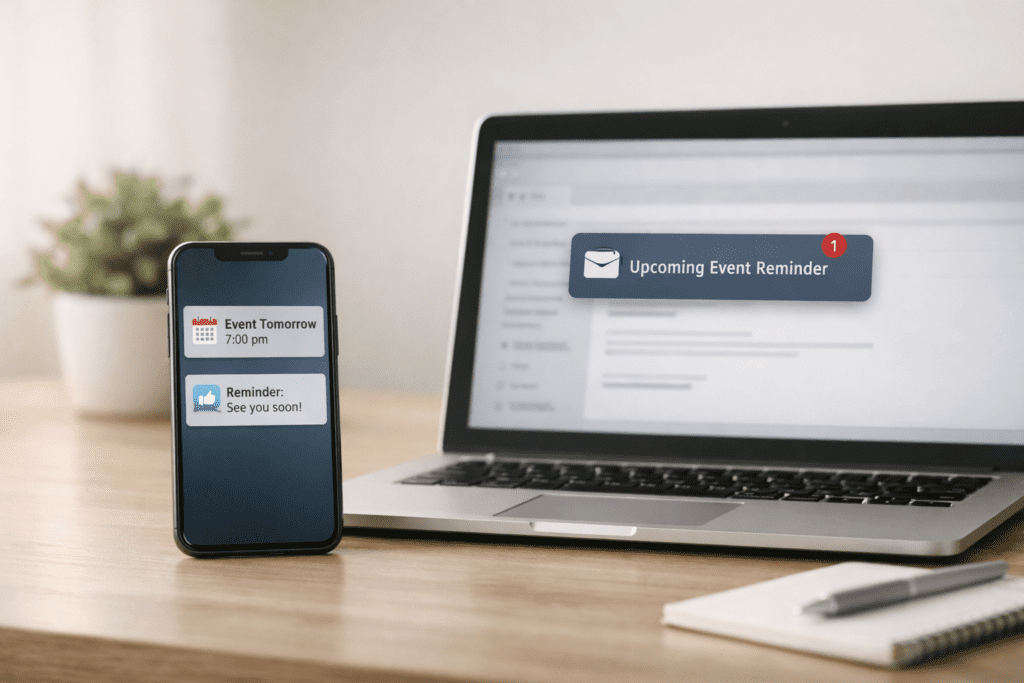
Event reminders are one of the simplest yet most powerful tools churches can use to improve attendance and engagement. When reminders are sent at the right time and through the right channel, they reduce uncertainty, help people plan ahead, and reinforce that each person’s presence matters.
Most churches already promote events well, but promotion alone does not guarantee attendance. Life gets busy, schedules change, and good intentions are often forgotten. This is where well-timed event reminders make a measurable difference.
This guide explains how churches can use text messages and emails together to create clear, helpful event reminders without overwhelming people. With the right structure and timing, reminders become a service to your congregation rather than an interruption.
Churches that rely on connected church event management tools are better equipped to plan, schedule, and automate these reminders consistently across all events.
How do churches manage event registration and reminders together?
The most effective reminder strategies begin at the moment someone registers for an event. Registration is more than a data collection step—it sets expectations for communication.
When someone signs up, they are signaling interest and availability. In return, churches have an opportunity to guide them through the event experience using thoughtful reminders.
A healthy registration-to-reminder flow includes:
- An immediate confirmation message that reassures the registrant
- Scheduled reminders that reinforce details over time
- Clear, consistent messaging across channels
This approach eliminates uncertainty. Attendees know what to expect, when to show up, and how to prepare.
When reminders are disconnected from registration, churches often fall into one of two traps: over-communicating to everyone or forgetting to follow up entirely. Keeping registration and reminders together creates clarity for both staff and attendees.
When should churches send event reminder text messages?
Text messages are best reserved for reminders that need immediate attention. Because texts are typically read within minutes, timing matters more than message length.
A proven schedule for church event text reminders looks like this:
- 3–5 days before the event: A friendly reminder with date, time, and location
- 24 hours before: A short confirmation that reinforces commitment
- Day-of (optional): A brief “starting soon” reminder for key events
Not every event requires all three. Small group meetings or recurring gatherings may only need a single reminder the day before.
Text reminders should always be concise. They work best when they answer one simple question: “What do I need to know right now?”
If additional details are required, the text can point people back to an email or registration page they already received.
When is email better than text for event reminders?
Email reminders provide space for context. While emails are not always read immediately, they allow churches to communicate more complete information without overwhelming readers.
Email is especially effective when attendees need to prepare, arrive early, or understand multiple components of an event.
Common uses for email reminders include:
- One-week reminders that help people plan their schedule
- Sharing agendas, parking details, or arrival instructions
- Volunteer coordination and role assignments
Email reminders also serve as a reference. Attendees can search their inbox if they forget details, reducing last-minute questions.
When churches coordinate email and text reminders through a single church communication system, messages feel intentional rather than repetitive.
How many event reminders are too many?
Church leaders often worry about sending too many reminders. While that concern is valid, most churches under-communicate rather than over-communicate.
The right number of reminders depends on the level of commitment required.
- Low-commitment events: One email and one text reminder
- Registered events: Confirmation, one email reminder, and one or two texts
- Volunteer-driven events: Additional reminders with role-specific details
The key factor is relevance. If each reminder adds value, people are far less likely to see it as spam.
Giving people control over communication preferences—especially opting out of texts—also builds trust and long-term engagement.
What information should every event reminder include?
Every reminder should reinforce the same core details. Even people who are excited about an event can forget practical information.
- What is the event?
- When does it start?
- Where is it happening?
- What should I do next?
Consistency across reminders prevents confusion. When details change, reminders should clearly highlight what is new.
Clear reminders reduce last-minute emails, phone calls, and hallway conversations, freeing staff to focus on ministry instead of logistics.
How should churches handle reminders for volunteers?
Volunteers often need more communication than attendees. They may need arrival times, assignments, and expectations.
Effective volunteer reminders often include:
- Earlier reminders than general attendees
- Clear role descriptions
- Confirmation requests when appropriate
Providing volunteers with timely reminders communicates respect for their time and contribution.
How do reminders differ for one-time vs recurring events?
One-time events benefit from a more structured reminder sequence because attendees are unfamiliar with the schedule.
Recurring events require a lighter approach. Too many reminders for weekly events can feel unnecessary.
A balanced strategy includes:
- More reminders for first-time attendees
- Fewer reminders as events become routine
- Additional reminders for schedule changes or special dates
This approach keeps communication helpful without becoming background noise.
How do automated reminders improve church event attendance?
Automation removes inconsistency from event communication. Once reminders are scheduled, they are delivered on time without manual effort.
This consistency builds trust. Attendees learn that your church communicates clearly and reliably.
Automation also helps churches scale. As events grow, communication remains organized without adding administrative burden.
Most importantly, automation frees church staff and volunteers to focus on people instead of processes.
FAQ: Church Event Reminders
Should churches always use text messages for reminders?
No. Text messages are best for urgent reminders, while emails work better for detailed information.
Is it okay to send reminders to people who didn’t register?
General announcements are fine, but personalized reminders should be reserved for registrants.
How far in advance should the first reminder be sent?
Typically 5–7 days before the event, depending on its importance.
Do reminders really reduce no-shows?
Yes. Clear, timely reminders help people plan and follow through.
Should volunteers receive different reminders?
Yes. Volunteers often need additional details and confirmations.
What is the biggest mistake churches make with reminders?
Sending reminders too late or including too much information in text messages.
Can automated reminders still feel personal?
Yes. When messages are relevant and well-timed, automation feels thoughtful rather than robotic.
Final thoughts on improving event reminders
Event reminders are more than operational messages—they are a way churches care for people’s time and attention. When reminders are timely, clear, and respectful, attendance improves naturally.
Churches that treat reminders as part of the event experience create smoother events, fewer misunderstandings, and stronger engagement.
If your church wants to simplify event scheduling, reminders, and follow-up, you can explore event communication solutions designed specifically for churches.