

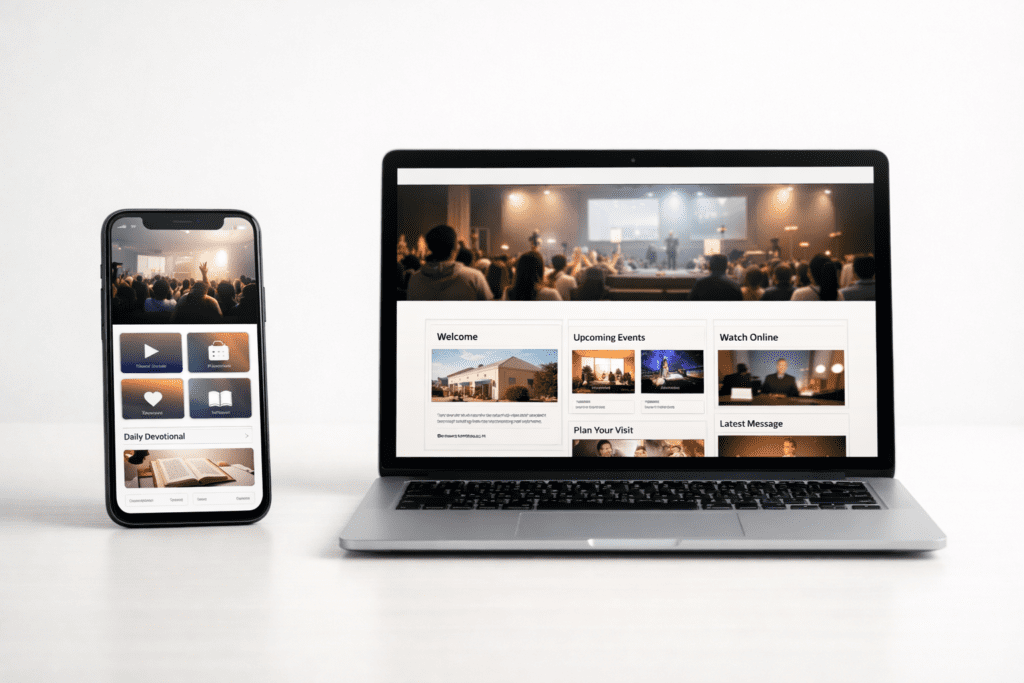
A church app is not automatically better than a website, but in the right context it can significantly improve engagement, communication, and consistency. The real question is not whether churches should have a mobile app, but when a church app actually adds value beyond what a website already provides. Making the right decision requires clarity about your church’s goals, audience, and current digital habits.
For many churches, digital tools have grown organically over time. A website was built first, then online giving was added, followed by livestreams, social media, and email communication. As expectations increase, church leaders often wonder if a mobile app is the next logical step or an unnecessary complication.
Do churches really need a mobile app?
Most churches do not need a mobile app by default. A strong website can effectively support communication, outreach, and basic engagement for a wide range of churches. A mobile app becomes valuable only when it solves specific problems that a website struggles to address.
Churches that benefit most from apps typically already have an engaged congregation that interacts with the church digitally throughout the week. If members frequently watch sermons, check announcements, register for events, or give online, an app can streamline and centralize those activities.
If, however, your church’s primary digital need is helping first-time visitors find service times, directions, or beliefs, a mobile app will not replace the role of a well-built website.
What role does a church website play today?
A church website remains the most important digital tool for visibility and accessibility. It is usually the first interaction a new visitor has with your church, often discovered through search engines or shared links.
Effective church website design focuses on clarity, speed, and trust. Visitors should quickly understand who you are, what you believe, and how to attend or get connected. Websites also serve as the foundation for SEO, helping people find your church when they search online.
Websites excel at:
- Serving first-time visitors and guests
- Providing public information without friction
- Ranking in search engines
- Sharing links across email and social media
Because websites require no installation and work across all devices, they remain essential regardless of whether a church also uses a mobile app.
Where websites start to fall short
While websites are excellent for discovery and information, they are not always ideal for repeated daily or weekly engagement. Members may forget URLs, navigate through multiple pages, or struggle to find the same content repeatedly.
Web-based communication also relies heavily on people choosing to visit the site. Unless someone intentionally opens the website, important updates can be missed. This is where mobile apps begin to offer a different type of value.
What does a church app do better than a website?
A church app is designed for ongoing engagement rather than discovery. Once installed, it lives directly on a person’s phone, making access faster and more habitual.
Apps reduce friction by putting core actions one tap away. Instead of opening a browser and navigating menus, members can quickly watch sermons, check upcoming events, or access giving options.
Key strengths of a church app include:
- Push notifications for timely communication
- Consistent weekly usage patterns
- Faster access to frequently used features
- A more personalized experience for members
This makes apps particularly useful for churches that want to strengthen midweek connection rather than relying solely on Sunday announcements.
How push notifications change church communication
One of the most significant differences between a website and an app is the ability to send push notifications. While emails and social posts can be missed, notifications appear directly on a phone’s screen.
When used carefully, notifications help churches share reminders, prayer updates, or last-minute changes without overwhelming people. The key is intentionality. Notifications should support ministry, not become digital noise.
Churches that succeed with apps often establish clear guidelines for when and why notifications are sent.
When does a church app actually make sense?
A church app makes sense when a church has clear engagement goals that extend beyond basic information sharing. Churches that benefit most often share several characteristics.
- Members engage digitally throughout the week
- Sermons are watched or listened to outside Sunday
- Multiple ministries or groups need coordination
- Leaders want a centralized digital experience
In these situations, investing in custom church app development allows churches to shape the app around real ministry needs instead of forcing members to adapt to generic tools.
Is a church app better for engagement?
A church app can improve engagement, but only when paired with a clear strategy. Simply launching an app does not automatically lead to higher participation or spiritual growth.
Apps work best when churches:
- Actively promote the app from the stage and online
- Keep content updated weekly
- Integrate the app into ministry workflows
- Teach members how and why to use it
Without these steps, an app can quickly become unused, regardless of how well it is built.
How churches should think about apps and websites together
For most churches, the decision is not between an app or a website. The healthiest digital strategies use both, each for its strengths.
The website serves as the public-facing front door, while the app functions as a members-focused engagement tool. When aligned correctly, the two reinforce each other rather than compete.
Church leaders should evaluate where friction exists today. If people struggle to stay informed, connected, or consistent, an app may help. If visitors struggle to find information or understand next steps, improving the website should come first.
Common mistakes churches make with mobile apps
Many church apps fail not because of technology, but because of unclear expectations. One common mistake is launching an app without defining what success looks like.
Other frequent issues include:
- Too many features with no clear focus
- Infrequent content updates
- Lack of leadership ownership
- No onboarding or promotion plan
Apps should simplify ministry, not add complexity. Fewer, well-used features often outperform feature-heavy apps that confuse users.
FAQ: Church Apps vs Church Websites
Is a church app only for large churches?
No. While larger churches often adopt apps earlier, smaller churches with engaged congregations can also benefit from a well-designed app.
Can a church have both a website and an app?
Yes. In fact, most churches should. Each serves a different purpose within a unified digital strategy.
Do church apps replace websites?
No. Websites remain essential for public visibility, SEO, and first-time visitors.
How often should a church app be updated?
At least weekly, with fresh sermons, announcements, or ministry updates.
What is the biggest mistake churches make with apps?
Launching an app without a clear purpose or long-term content plan.
Are church apps difficult for members to use?
When designed well, apps are usually easier and faster to navigate than websites.
What should churches plan before building an app?
Clear goals, content ownership, and how the app supports real ministry engagement.
If your church is evaluating whether a mobile app fits into your broader digital strategy, it helps to step back and look at how all your tools work together. You can explore church technology solutions to better understand how websites, apps, and communication platforms align with ministry goals.