

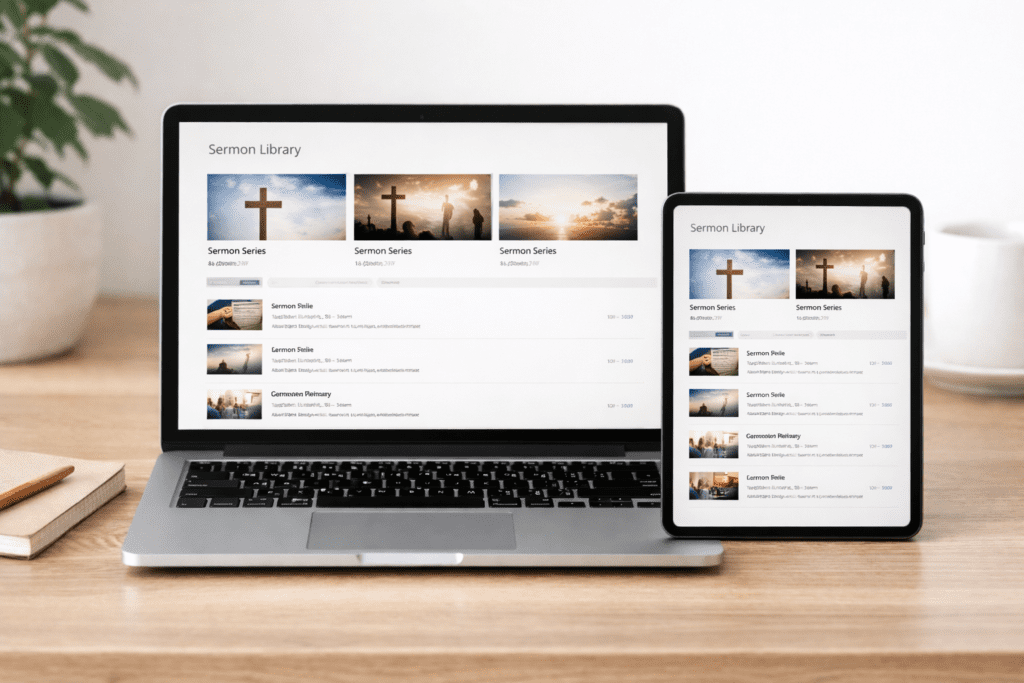
A well-organized sermon archive helps people stay connected to your church’s teaching far beyond Sunday morning. When sermons are easy to find, clearly labeled, and consistently published, your archive becomes a long-term ministry resource rather than just a storage location for old messages.
Sermon archives serve multiple audiences at once. Members use them to revisit teaching and reflect throughout the week. Guests use them to understand your theology and teaching style before attending. Leaders rely on them for discipleship, small groups, and training. This guide covers sermon archive best practices that help churches organize messages effectively, improve discoverability, and serve their community well.
How should a church organize a sermon archive?
A church sermon archive should be organized around how people naturally look for sermons. Most listeners are not searching by file name, upload order, or internal labels. Instead, they are looking for a series they remember, a topic they are wrestling with, or a pastor they trust.
The most effective sermon archives use a simple, predictable structure that includes:
- Sermon series as the primary organizational unit
- Individual sermons nested clearly within each series
- Clear sermon titles that describe the message rather than internal shorthand
- Consistent use of dates and speaker names
This structure lowers the learning curve for visitors and removes friction for regular attenders. People should never need instructions to find sermons. Your sermon archive should also be easy to locate from your main navigation or homepage. Thoughtful church website design ensures sermon content is accessible without overwhelming visitors or burying important resources.
What information should every sermon archive include?
Every sermon entry should give enough context for someone to decide whether the message is relevant to them. Missing or inconsistent details often lead people to leave the page or assume content is outdated or incomplete.
At a minimum, each sermon archive entry should include:
- A clear sermon title that reflects the message content
- The sermon series name
- The date the sermon was preached
- The speaker or pastor
- An audio and/or video playback option
When available, churches may also include sermon notes, scripture references, or discussion questions. These elements add value for small groups and personal study without significantly increasing maintenance effort—especially when teams already prepare outlines or notes internally.
Consistency matters just as much as completeness. It is better to include the same core information on every sermon than to include extra details sporadically.
Should sermons be organized by series, topic, or date?
The best sermon archives support multiple ways to browse. While sermon series should be the default organizational method, additional filters help people with different needs and learning styles.
Strong sermon archives often support browsing by:
- Series, which provides narrative flow and teaching continuity
- Speaker or pastor, for those following specific voices
- Topic or theme, for focused study or life questions
- Year or date range, for historical reference or review
This layered approach serves both long-time members who follow series closely and first-time visitors who may be exploring your teaching for the first time. Offering multiple entry points helps people engage with sermons on their own terms.
How can a sermon archive support engagement beyond Sunday?
A sermon archive extends the impact of your teaching throughout the week. Instead of sermons being a one-time event, they become ongoing resources that people can revisit, reflect on, and share.
Churches commonly use sermon archives to:
- Support small group and Bible study discussions
- Help members catch up after missed services
- Encourage personal reflection and prayer during the week
- Share messages with friends, family, or seekers
When sermons are easy to access, engagement increases naturally. People are more likely to share messages when links are reliable and content is clearly presented. Centralizing sermons using dedicated church sermon management tools can also help teams avoid fragmentation across platforms and simplify long-term organization.
What role does consistency play in sermon archives?
Consistency is one of the most overlooked elements of effective sermon archives. When people know what to expect, they are more likely to return.
Consistency includes:
- Using the same naming format for sermon titles
- Publishing sermons on a predictable schedule
- Displaying information in the same order for every message
- Maintaining the same navigation structure over time
Even small inconsistencies can create confusion, especially for visitors. A consistent archive communicates care, organization, and reliability.
What common mistakes should churches avoid with sermon archives?
Many sermon archives become difficult to use over time because they grow without clear standards. Avoiding a few common mistakes can keep your archive usable and welcoming.
- Inconsistent sermon titles or unclear naming conventions
- Missing speaker names or sermon dates
- Broken media links or unavailable playback
- Hosting sermons across disconnected systems
- Letting older sermons become hard to find or navigate
Simplicity and consistency matter more than advanced features. A basic structure that is maintained regularly will outperform a complex system that is confusing or outdated.
How often should a sermon archive be updated?
A sermon archive should be updated as soon as possible after each service. Timely publishing reinforces trust and helps people engage while the message is still fresh.
Many churches aim to publish sermons:
- The same day as the service
- Within 24 hours
- On a consistent weekly schedule
Whatever timeline you choose, consistency matters more than speed. Setting clear internal expectations helps both your team and your congregation.
Frequently Asked Questions About Sermon Archives
What is a sermon archive?
A sermon archive is a structured library of past sermons that allows people to browse, listen to, or watch church messages online.
How many sermons should a church keep available?
Many churches keep several years of sermons online, depending on relevance, storage capacity, and ministry goals.
Are sermon archives only useful for large churches?
No. Churches of any size benefit from a sermon archive that makes teaching accessible and easy to share.
Should sermons be audio, video, or both?
Audio is convenient for listening on the go, while video provides a fuller worship experience. Offering both serves a wider audience.
Do sermon archives help with outreach?
Yes. Sermon archives allow visitors to explore your teaching before attending and share messages with others.
How do sermon archives support discipleship?
They help members revisit teaching, reflect on scripture, and apply messages throughout the week.
What is the first step to improving a sermon archive?
Start by standardizing sermon titles, series names, and required information for every message.
Next step: If your team wants to simplify how sermons are organized and shared, take time to explore our church solutions and see how everything can work together.